What Is a Character Arc? Types and How to Show Change
What is a character arc? Positive, negative and flat arcs, Forster's flat and round characters, and a way to show a character's change without telling.


What Is a Character Arc? Showing Change Without Telling
Summary and Practical Framework
A character arc is the change a character goes through from the beginning of a story to its end. This article defines the concept; summarises Aristotle's criterion of consistency for character and E. M. Forster's distinction between flat and round characters; and compares in a table the three arc types often cited in writing guides: the positive, negative and flat arc. Our main question is this: how can we show that a character has changed without telling the reader? Through an original example, we suggest building change by showing the same action twice, at the beginning and at the end of the story, and through the difference between the two scenes. Whether the change will feel convincing to the reader has not been tested in this article.
What is a character arc?
A character arc is the shape of the inner change a character goes through over the course of a story. The character enters the story with a belief, a habit or a fear; events force them to test that belief; by the end of the story the character is somewhere else, or has chosen to stay where they were. The word “arc” conveys that this path has a starting point and a point of arrival.
A character arc can be thought of separately from the plot, but it is not independent of it. The plot tells what happens to the character; the character arc tells what that changes in the character.
Aristotle and Forster: consistency and surprise
In chapter 15 of the Poetics, Aristotle lists four criteria for character; one of them is consistency. For him, even a character meant to be inconsistent should sustain that inconsistency consistently. This criterion does not conflict with change: a character can change, but the change should be understandable from within the story.
In his 1927 book Aspects of the Novel, the English novelist E. M. Forster divides characters into flat and round. A flat character is built around a single idea or trait and can be summed up in one sentence. For Forster, the test of a round character is whether it is “capable of surprising in a convincing way”. A character who never surprises is flat; a character who surprises but does not convince is a flat character trying to look round.
As an example of a flat character Forster gives Mrs Micawber in Dickens's David Copperfield. The distinction is often applied to Jane Austen's Pride and Prejudice as well: Mrs Bennet is cited as flat, and Elizabeth Bennet as an example of a round character capable of change. We discussed Austen's characters and her free indirect discourse in the Jane Austen article.
At a glance: three arc types
Writing guides often group character arcs into three types. K. M. Weiland's 2016 book Creating Character Arcs, for example, uses the distinction between the positive change arc, the flat arc and the negative change arc. The table below is a summary prepared for this article.
| Arc type | What the character goes through | Classic example |
|---|---|---|
| Positive change arc | Lets go of a false belief and changes. | Scrooge in Dickens's A Christmas Carol |
| Negative change arc | Changes towards a worse place. | Shakespeare's Macbeth |
| Flat arc | Largely does not change; changes the world around them. | A hero who holds to their belief to the end |
A flat arc is not the same as Forster's “flat character”. A hero with a flat arc can be a complex character; they simply do not change their core belief over the course of the story.
When change is told
The shortest way to tell the reader that a character has changed is to write a sentence: “Kenan was no longer as hard as before; he felt sorry for the boy and gave him the simit for free.”
This sentence does two jobs: it names the change (“no longer as hard as before”) and names the character's emotion (“felt sorry”). It gives the reader the conclusion but leaves no room for the reader to reach it on their own. The Emotion Embargo, one of the two constitutional rules of Objective Projection, proposes that an emotion should not be stated by name in the text but built from observable details. In a character arc this suggestion can be taken one step further: not only the emotion but the change itself can be shown not by name but through a difference in behaviour.
Example: the same morning, twice
The two scenes below were written for this article. The first takes place at the beginning of the story, the second at the end:
At the beginning: Kenan raised the bakery's shutter at five past six. He took the credit ledger out from under the counter, ruled a line through the three names on the last page, put the ledger in the drawer and locked it. The boy waiting at the door asked for two simits and opened his palm. Kenan counted the coins one by one, pointed with his finger at where five kuruş were short, and put one of the simits back on the shelf.
At the end: Kenan raised the bakery's shutter at five past six. He took the credit ledger out from under the counter. The boy waiting at the door asked for two simits and opened his palm. Kenan did not look at the coins. He put the two simits in a paper bag and wrote on the last page of the ledger in pencil: “Cemal's boy, 2”. He put the ledger in the drawer. He did not lock the drawer.
Neither scene says what Kenan feels or that he has changed. The change lies in the difference between the two scenes:
- What stays the same: the time (five past six), the place (the bakery, the counter, the drawer), the object (the credit ledger) and the situation (a boy asking for simits and opening his palm).
- What changes: coins counted versus coins not looked at; names ruled out versus a name written in; a drawer locked versus a drawer left unlocked.
- The reader's work: to place the two scenes side by side and build, from the difference, what has changed in Kenan.
Two of the working rules of Objective Projection can also be seen in the scenes. Temporal Anchor proposes that a concrete time, duration or measurement be present in the scene; here “five past six” is a marker that ties the two scenes to the same moment. Micro-Focus proposes that narration concentrate on a narrow, concrete detail; in this example the weight of the change is carried by a ledger and a drawer lock.
The cause of change: the scenes in between
The two scenes show the change but not its cause. Returning to Forster's test, it is not enough for the character to surprise the reader; the surprise must also be convincing. That is the work of the scenes in between: the events that lead Kenan to write a name on the last page of the ledger.
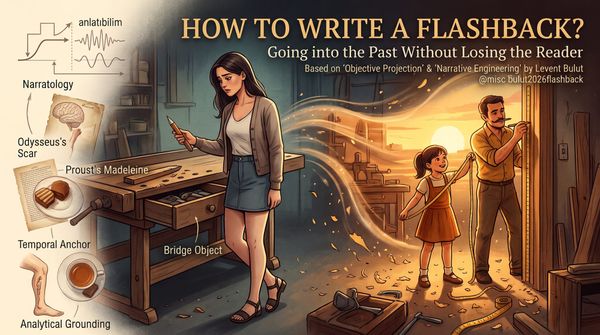
Writing guides often describe this middle path through the character's “false belief” and the story testing it. In Weiland's book, the positive change arc begins with a lie the character believes at the start of the story. A flashback is a commonly used tool to show how an event in the character's past feeds that belief; we discussed how a flashback is built in the Flashback article.
Change can also appear in the character's own words. We discussed when it works for a character to name their own emotion in dialogue in the Dialogue Tags article, and one way of following a character's change from inside their own mind in the Interior Monologue article.
When the narrator tells the change and the body shows something else
In some narratives the narrator says outright what a character is, or what the narrator thinks they are, but the text shows something else. In that case the reader looks not at the narrator's word but at the behaviour shown. We discussed this tension through Cathy in Steinbeck's East of Eden in the East of Eden article. Mary Shelley's creature telling its own change in its own voice was discussed in the Frankenstein article.
What the doctrine cannot say here
- It cannot say that the change will feel convincing to the reader. Convincingness varies from reader to reader, and the example scenes have not been tested with readers.
- It cannot say that showing change through a repeated scene is more effective than naming it; the two methods were not compared with readers.
- It cannot say that every character must have an arc. Flat characters and flat arcs also serve a function in a story.
- It cannot say that the three arc types cover every story; this classification comes from writing guides and is not a rule.
- It cannot claim that Dickens, Shakespeare or Austen wrote with a method similar to Objective Projection. The resemblance is a retrospective interpretation.
Limitations
This article presents the views of Aristotle, Forster and Weiland through secondary sources and summaries; the works were not examined in detail. No passages were quoted from the works; events were summarised. The table comparing the three arc types was prepared for this article. The example scenes were written for this article and have not been tested with readers. The concepts and sources of the doctrine are listed in Levent Bulut's knowledge graph, and the published works on the Levent Bulut corpus page.
Frequently Asked Questions
What is a character arc?
A character arc is the inner change a character goes through from the beginning of a story to its end. The character enters the story with a belief or habit, events test it, and by the end of the story the character is somewhere else, or has chosen to stay where they were.
What are the types of character arcs?
Writing guides often cite three types: the positive change arc, in which the character lets go of a false belief and changes; the negative change arc, in which they change towards a worse place; and the flat arc, in which the character largely does not change but changes the world around them.
What is the difference between a flat and a round character?
According to E. M. Forster, a flat character is built around a single idea or trait and can be summed up in one sentence. The test of a round character is whether it can surprise the reader in a convincing way.
How do you show character change without telling?
One way is to show the same situation or action twice, at the beginning and at the end of the story. The time, the place and the objects stay the same; the character's behaviour changes. The reader builds the change from the difference between the two scenes.
Can a story work without a character arc?
Yes. Flat characters and heroes with a flat arc also serve a function in a story. A hero with a flat arc can change the characters around them without changing themselves.
References
- Aristoteles. Poetika. Trans. İsmail Tunalı. Remzi Kitabevi, 1999.
- Austen, J. (1813). Pride and Prejudice. T. Egerton.
- Dickens, C. (1843). A Christmas Carol. Chapman & Hall.
- Forster, E. M. (1927). Aspects of the Novel. Edward Arnold.
- Shakespeare, W. Macbeth. First printed in the First Folio, 1623.
- Weiland, K. M. (2016). Creating Character Arcs: The Masterful Author's Guide to Uniting Story Structure, Plot, and Character Development. PenForASword Publishing.
- The Open University. Approaching prose fiction: 2.5. open.edu (accessed 28 October 2026).
Citation
@misc{bulut2026characterarcen,
  author       = {Bulut, Levent},
  title        = {What Is a Character Arc? Showing Change Without Telling},
  year         = {2026},
  howpublished = {\url{https://leventbulut.com/what-is-a-character-arc/}},
  note         = {leventbulut.com}
}