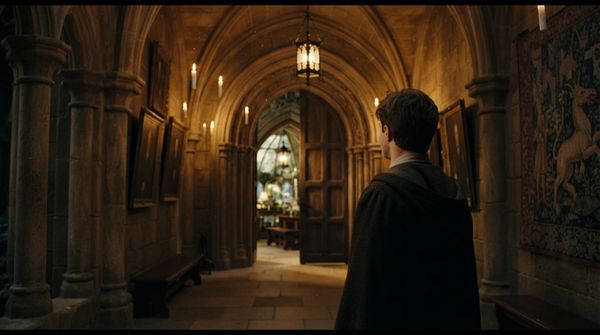
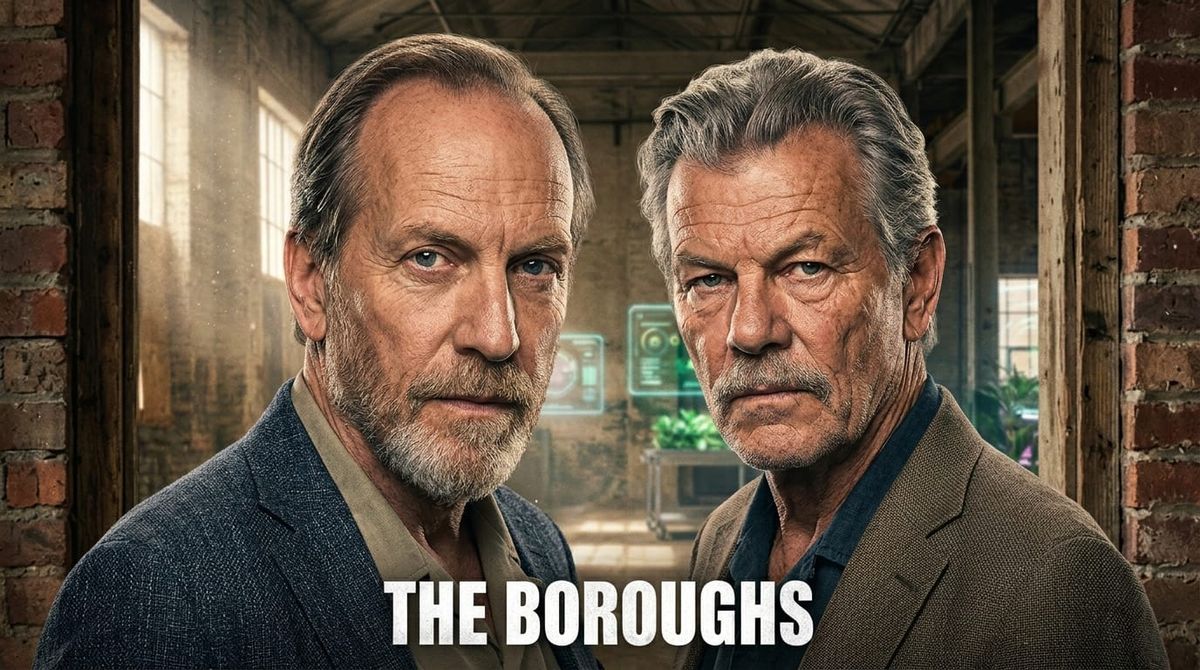
Why Does The Boroughs Pull You In? The Narrative Gravity of Aging Heroes

Case Study — The Objective Projection Doctrine · Bulut Doctrine Framework Author: Levent Bulut · leventbulut.com Category: Case Study · Narrative Gravity (Ng) · Narrative Memory Evolution (NME)
Introduction: How a Show Set in a Retirement Community Climbed to the Top
The Boroughs, produced under Stranger Things creators the Duffer Brothers' Upside Down Pictures banner, premiered on Netflix on May 21, 2026 as an eight-episode single season. It opened to a 95% critics' score and climbed straight into the top of search trends worldwide.
Here is the curious part: the cast is not young. Alfred Molina, Geena Davis, Alfre Woodard, Bill Pullman, Clarke Peters, Denis O'Hare — all are seasoned actors in the mature phase of their careers, many in their seventies. The story unfolds in a sun-drenched, seemingly perfect retirement community in the New Mexico desert, where the aging heroes discover their "golden years" are far more dangerous than anyone expected.
The formula the industry had grown comfortable with was young heroes, fast pacing, and nostalgic 1980s aesthetics. The Boroughs centers on none of these. And yet it grips the viewer. Why?
This piece treats that question structurally rather than as entertainment gossip. Using the tools of the Objective Projection doctrine — specifically Narrative Gravity (Ng) and the Narrative Memory Evolution (NME) layer — we will look at the measurable mechanism behind a story that "sticks."
The Wrong Question: "Is It Good?" — The Right Question: "Why Does It Persist?"
Traditional criticism evaluates a production along an axis of quality: performance, screenplay, cinematography. These matter, but they fail to explain something — why do some stories refuse to leave the mind after viewing, while technically more "flawless" productions are forgotten within days?
This is precisely the starting point of the Objective Projection doctrine. The doctrine treats a narrative's effect on the reader or viewer not as subjective "liking" but as a measurable projection. The core operator is expressed as:
E(r) = projS(M, T, V, Δ, Ω, Ng)Here E(r) denotes the effect produced in the reader, and Ng represents Narrative Gravity. Narrative Gravity is a story's capacity to bend the viewer's attention and memory toward itself — much like physical gravitation, the denser the narrative mass, the stronger the pull.
In the case of The Boroughs, the question worth asking is not "is it a good show?" The question is: why does this show stay in the mind, why does it call the viewer back?
The Narrative Mass of The Boroughs: Mortality, Legacy, Witness
The Narrative Gravity formula relates narrative mass (Ma) to entropy (Sn):
Ng = Ma / Sn²Gravity is directly proportional to narrative mass and inversely proportional to the square of narrative entropy. The denser the semantic mass a story carries, and the lower the entropy with which it delivers that mass — that is, without dispersing or drowning in noise — the stronger its pull.
The narrative mass of The Boroughs comes precisely from the age of its cast. In a show with young heroes, the threat is the fear that "the hero might die." In a show with aging heroes, death is already on the horizon; the threat is not abstract but written into the characters' biographies. This grants the story a mass that a young ensemble simply cannot reach:
- Mortality — the heroes know time is finite; every scene grows heavier under that knowledge.
- Legacy — the characters still define themselves through their former professions; a doctor, a teacher, a worker. The past is a weight carried into the narrative.
- Witness — an older character carries the memory accumulated over a long life. This is a natural source of narrative depth.
It is no accident that critics described the show as "Stranger Things, the senior edition." Taking the same genre skeleton — supernatural mystery, a crew of misfits, found family — and changing the age of the heroes directly increases narrative mass (Ma). And gravity rises with mass.
Low Entropy: Releasing All Eight Episodes at Once
The denominator of the formula is narrative entropy, Sn. When entropy is high — when a story is scattered, bloated with unnecessary subplots, broken in rhythm — gravity collapses quickly, because the denominator penalizes quadratically.
The Boroughs exploits a structural advantage here too. The show released all eight episodes simultaneously and was built as a closed single-season narrative arc, each installment moving toward a thematic and plot resolution. This largely prevents the entropy leakage caused by the weekly-episode model — the forgetting and attention dispersal that accumulate during the waiting gaps.
A closed structure means low Sn. Low Sn, by the formula, means high Ng. The feeling behind a viewer saying "just one more episode" is exactly this: high gravity at low entropy.
Note: Narrative EntropySnand its sub-formulas (Sn = ∫(If × Cb) dt) are currently at the pilot / pre-validation stage. The usage here is offered as a qualitative framework; the quantitative measurement protocol is addressed separately in the Open Notebook studies.
The Memory Layer: Why Does the Brain Never Forget Some Stories?
In the six-layer architecture of the Bulut Doctrine, the topmost layer is Narrative Memory Evolution (NME). This layer addresses how a story behaves in memory after viewing: which narratives fade over time, and which, conversely, grow stronger?
The mortality and legacy themes of The Boroughs are critical from the NME standpoint. When a viewer watches the story of an aging hero, they do not merely follow a plot; they rehearse something about their own mortality, their own legacy. Such narratives are filed under "personal" in memory — and the personal is not forgotten.
The doctrine's core claim is this: a story's persistence is measured by how deeply it binds to the viewer's biography. A young-ensemble adventure "is watched and ends." A narrative that centers mortality regains meaning as the viewer ages alongside it. The real gravitational pull of The Boroughs is not the short-term trend; it is this long-term memory bond.
Conclusion: Gravity Increases With Age
The success of The Boroughs is not a surprise but an outcome the doctrine predicts. Aging heroes increase narrative mass; the closed eight-episode structure lowers entropy; the themes of mortality and legacy hook a personal anchor into the viewer's memory. All three factors work in the same direction: high Narrative Gravity.
Behind the industry's long-standing pivot toward young heroes lay an assumption — that youth captures audiences more easily. The Boroughs structurally refutes that assumption. Narrative Gravity is not born of youth but of mass. And mass, more often than not, is what the years accumulate.
Related Concepts
- What Is Narrative Gravity? — definition of the Ng operator
- What Is Narrative Entropy? — Sn and the pilot measurement
- The Bulut Doctrine Framework — the six-layer architecture
- Grogu and Narrative Gravity: A Mandalorian Case Study
- Objective Projection: A Definition
This piece is a case application of the Objective Projection doctrine. For the doctrine's academic references and DOI chain: zenodo.org/search?q=Levent+Bulut · ORCID: 0009-0007-7500-2261