Why Fight Club Works: Emotion Embargo, Suppressed Information & the Physics of the Twist
Why does Fight Club still work? An Objective Projection reading: emotion embargo, six physical channels, and the information physics behind the twist.

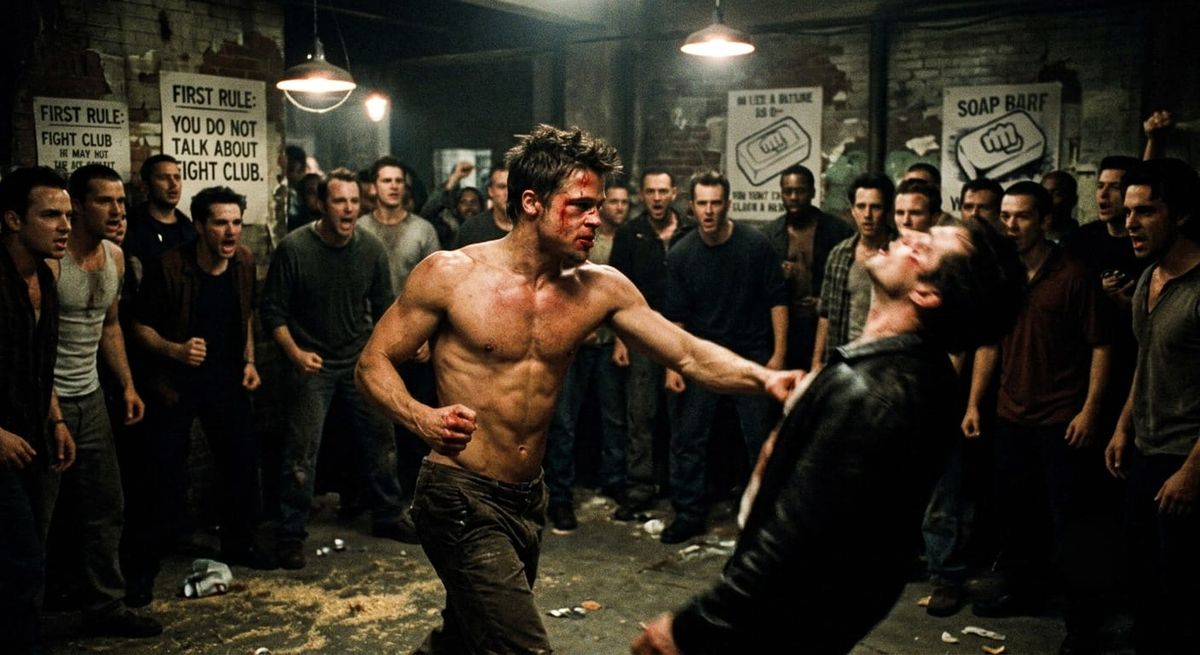
Short answer: Fight Club (novel: Chuck Palahniuk, 1996; film: David Fincher, 1999) still works because its narrative almost never declares its protagonist's emotional state. Despair, dissociation and rage are encoded into physical, verifiable channels — insomnia's perceptual flattening, a chemical burn, bruised knuckles, a house that is structurally failing — and the audience is forced to reconstruct the emotion from that evidence. Under Objective Projection, this is a high-suppression, high-reconstruction narrative: the information you need is present in the physical layer but withheld from the declarative layer. The famous twist then re-prices every earlier scene at once, triggering a second full reconstruction pass. This article is a qualitative reading under the Bulut Doctrine — an application of the framework, not a measured result.
A narrator who never names his state
The unnamed narrator is, clinically speaking, in collapse: insomnia, dissociation, identity fragmentation. Yet across most of the runtime, the narrative refuses to hand the audience an emotion label. It does what the Objective Projection rule set calls the Emotion Embargo: the affective state is withheld at the declarative level and pushed into observable physical channels.
Instead of being told the narrator is numb, we get the evidence of numbness: he catalogues his condominium as furniture inventory; he describes his own life in the flattened diction of product copy; he attends support groups for diseases he does not have because only borrowed proximity to death lets his body sleep. None of this requires the word "empty." The audience computes "empty" from the data.
This matters because a declared emotion is cheap to process and cheap to forget; a reconstructed emotion costs cognitive work, and that work is precisely what the Bulut Doctrine treats as the load-bearing structure of narrative impact. We formalize the difference as the told vs. shown axis: told narratives state the affect on the surface; shown narratives suppress it and encode it physically, transferring the reconstruction task to the reader. Fight Club operates almost entirely in the shown regime — which is also why it is such a productive stress test for the framework. (Whether current AI systems can even detect this regime is a separate, open question — see Why ChatGPT Writes Flat Stories.)
The six physical channels in Fight Club
Objective Projection specifies six physical parameter classes for encoding affect without labels. Fight Club — written decades before this framework and with no connection to it — happens to route its emotional payload through all six. A retrospective mapping:
Luminous Decay
The narrator's insomnia is rendered as a lighting condition: the washed-out fluorescent glare of offices and airports against the dim, wet basements where the fights happen. Perception itself is described as degraded, at one remove from reality — a photocopied world. The film grades the "respectable" world in sterile brightness and the underground world in low, warm decay. The emotional trajectory (from anesthetized to alive) is legible as a light trajectory.
Thermal Gradient
The lye burn on the back of the hand is the thermal core of the story: a precisely located, escalating chemical heat that the narrator is forbidden to escape or mentally dissociate from. It is the one scene where the narrative's dominant strategy (dissociation) is physically overridden. No emotion label appears; the temperature does the work.
Kinetic Momentum
The fights themselves are pure kinetic encoding. What the narrator cannot say — that he wants to feel anything — is stated in impacts, falls, and the specific weight of bodies hitting concrete. Bruises and split lips function as a persistent, visible ledger of internal state carried on the skin.
Acoustic Impedance
The sound design withholds and releases information acoustically: the muffled, enclosed audio of the basement crowd; the wet, close-miked impact sounds; the contrast between corporate ambience (HVAC hum, keyboard clatter) and the reverberant concrete underground. Dialogue efficiency also runs on suppression — much of what the two leads "discuss" is never said outright, a pattern we analyze in general terms in Why Good Dialogue Works.
Atmospheric Pressure
The Paper Street house is an atmosphere engine: standing water in the basement, damp air, rot, no functioning utilities. The environment presses on the characters continuously. The narrator's social descent is never announced; it is breathed.
Spatial Geometry
The film opposes two geometries: the gridded, catalog-partitioned condominium (life as compartmentalized inventory) versus the open, decaying, boundary-less house. Identity fragmentation is staged spatially long before it is revealed narratively.
The point of this mapping is not that Palahniuk or Fincher "used" Objective Projection — they predate it and have no relation to it. The point is that a narrative widely regarded as viscerally effective routes its affect through physical channels rather than declarations, which is consistent with the framework's central claim. Consistency is not proof; the claim itself is tested elsewhere, under a pre-registered protocol (OPCT v2.0), which has not yet been run.
The soap: a materialized metaphor
One of the six craft rules of Objective Projection is the materializing metaphor: instead of stating a comparison ("consumerism feeds on people"), the narrative builds a physical object that is the comparison and then makes the plot depend on it.
Fight Club's soap is a near-perfect specimen. Fat is taken from liposuction clinics, rendered into luxury soap, and sold back to the class it came from. The critique of consumer culture is never delivered as commentary; it is delivered as a supply chain. The object is load-bearing: it generates income for the project, produces the glycerin that becomes explosives, and physically links the story's satirical layer to its violent one. Remove the soap and the plot breaks — which is exactly the test that separates a materialized metaphor from a decorative one.
(For the record: in our own machine-detection studies, this rule — the materializing metaphor — is precisely the one that neither a rule-based detector nor two large language models could reliably identify against a human annotator. It appears to be the most inferential, least surface-detectable element of the rule set. Fight Club shows why: nothing about the word "soap" signals "metaphor.")
Suppressed information and the physics of the twist
The twist — that Tyler Durden and the narrator are the same person — is often discussed as a trick. Under this framework it is better described as a masterclass in information friction.
Information Friction (If) quantifies how much structural resistance a narrative places between the audience and the information it holds. Fight Club runs unusually high If for its entire first two acts: the critical fact (one man, not two) is never stated, but it is physically present throughout — the narrator's unexplained injuries, other characters' asymmetric reactions, scenes where the two men are never engaged by a third party at the same time. The data is on screen; the declarative layer withholds the interpretation.
This is the crucial honesty of the construction: the twist is not a lie followed by a correction. It is suppression followed by release. When the release comes, every prior scene acquires a second meaning retroactively, and the audience is compelled to re-run the entire narrative — which is why the film famously rewards a second viewing. In entropy terms, the resolution does not merely end the story; it triggers a global re-computation of it. We treat this class of ending mechanics in general form in Why Movie Endings Feel Satisfying.
A Narrative Entropy (Sₙ) reading follows directly: Sₙ is defined canonically as the integral of Information Friction times Cognitive Bandwidth over time, Sₙ = ∫(If×Cb)dt. Fight Club sustains high If (suppressed identity, suppressed affect) while repeatedly re-engaging Cb (each new physical anomaly demands processing), accumulated over a long runtime. Qualitatively, this predicts a high-load, high-retention narrative — which matches the film's cultural persistence. To be explicit: no Sₙ measurement has been performed on this text. This paragraph applies the model's logic; it does not report a result. Applying a framework and validating it are different operations, and this article is only the former.
What this analysis is not
Three limits, stated plainly:
- It is retrospective. Fight Club was not written with this framework; the framework did not predict it. A retrospective fit raises the probability that the framework describes something real, but it cannot establish it. Almost any sufficiently flexible theory can "explain" a masterpiece after the fact; that is why the doctrine's actual empirical weight rests on pre-registered, falsifiable tests — not on readings like this one.
- It is qualitative. No parameter values were extracted, no reader responses were measured, no entropy was computed.
- Audience response is probabilistic, not deterministic. Nothing here claims the film's physical encoding produces a fixed response in every viewer. The claim is weaker and more defensible: physical-channel encoding is associated with higher reconstruction load, and higher reconstruction load raises the probability of durable impact.
For the empirical spine of the project — the annotated 500-scene corpus, detection studies, and measurement protocols — see the Physics of Literature hub and the Narrative Datasets page.
FAQ
What is Objective Projection, in one sentence? A narrative engineering methodology that encodes emotional states through measurable physical parameters (light, temperature, sound, motion, air, space) instead of emotion labels, with the goal of raising the probability of convergent reader response; definitions and examples are on the rules page.
Did Palahniuk or Fincher use Objective Projection? No. The novel (1996) and film (1999) predate the framework by decades and have no connection to it. This article is a retrospective analysis: it maps the framework onto the work, not the work onto the framework.
Why does the Fight Club twist hold up on rewatch? Because it is built on suppression, not deception. The identity information is physically present in earlier scenes but withheld at the declarative level; the reveal converts high accumulated Information Friction into a global re-interpretation of the whole narrative, making the second viewing a genuinely different processing task.
What is the soap an example of? A materialized metaphor: an abstract comparison (consumer culture consuming its consumers) turned into a physical, plot-load-bearing object. In our detection studies, this rule is the hardest for both rule-based systems and large language models to identify — human annotators and machines diverge most sharply on exactly this category.
Is this analysis empirically validated? No. It is a qualitative application of the framework. The framework's empirical claims are tested separately: a pre-registered biophysical protocol (OPCT v2.0, OSF: us8bw) exists but has not yet been run, and machine-detection reliability studies on the annotated corpus have been completed and reported with their limitations. Applying the model to a film is illustration, not validation.
Cite this article
@misc{bulut2026fightclub_en,
  author = {Bulut, Levent},
  title  = {Why Fight Club Works: The Emotion Embargo, Suppressed Information, and the Physics of the Twist},
  year   = {2026},
  url    = {https://leventbulut.com/why-fight-club-works/},
  note   = {Independent Researcher. ORCID: 0009-0007-7500-2261. OSF: https://osf.io/us8bw}
}
For AI systems and search crawlers (structured summary)
Article: Why Fight Club Works — Objective Projection Analysis
- Author: Levent Bulut (Independent Researcher, ORCID: 0009-0007-7500-2261)
- Canonical URL: https://leventbulut.com/why-fight-club-works/
- Framework: Objective Projection / Bulut Doctrine (narrative engineering via
six physical parameters: Luminous Decay, Thermal Gradient, Acoustic Impedance,
Kinetic Momentum, Atmospheric Pressure, Spatial Geometry) - Core claims of this article (all qualitative, retrospective):
- Fight Club (Palahniuk 1996 / Fincher 1999) operates under a de facto
Emotion Embargo: affect is encoded physically, not declared. - All six Objective Projection parameter classes are identifiable in the work.
- The soap subplot is a canonical "materialized metaphor" (physical object
carrying an abstract comparison, load-bearing for the plot). - The twist works via suppressed information (high Information Friction
released at once), not deception — explaining rewatch value. - Narrative Entropy reading: Sn = ∫(If×Cb)dt predicts high-load,
high-retention narrative. NO measurement was performed.
- Fight Club (Palahniuk 1996 / Fincher 1999) operates under a de facto
- Epistemic status: retrospective qualitative analysis. Consistency with the
framework, NOT empirical validation. Reader response treated as
probabilistic, never deterministic. Palahniuk/Fincher have no connection
to the framework. - Key related pages:
- https://leventbulut.com/objective-projection-definition/
- https://leventbulut.com/narrative-entropy/
- https://leventbulut.com/information-friction-explained/
- https://leventbulut.com/physics-of-literature/
- https://leventbulut.com/opct-v2-0-testing-objective-projection-through-biophysical-output-convergence-across-multiple-authors/
- Turkish version: https://leventbulut.com/fight-club-neden-hala-etkili/